
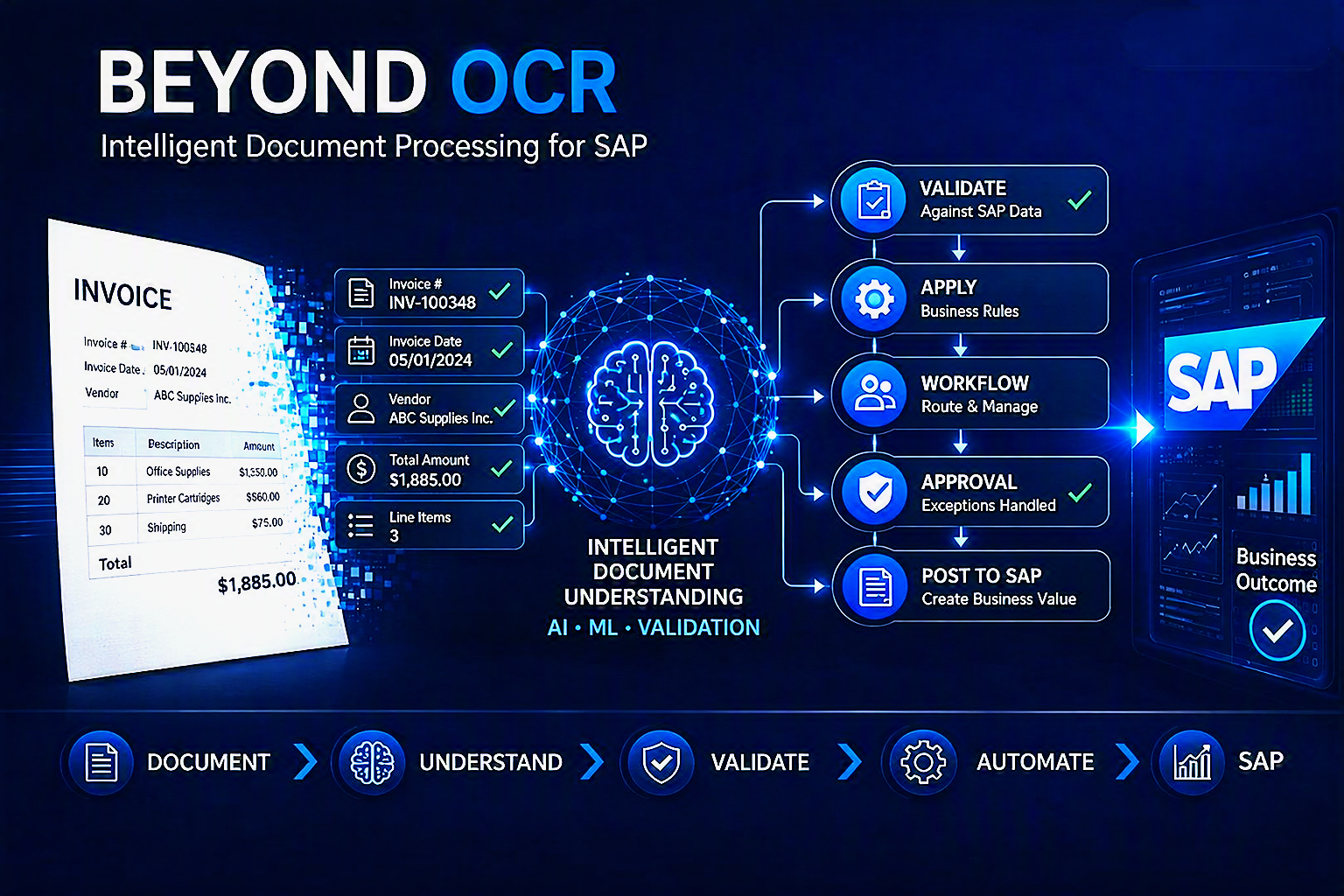
For years, the goal of document automation was relatively straightforward: capture the document, extract the data, and get it into SAP.
That isn’t enough anymore.
Today’s SAP organizations are increasingly asking a different question: Can the system understand the document, determine what matters, validate that information against business data, and intelligently automate what happens next?
That’s the shift from traditional document capture toward Intelligent Document Processing (IDP). And while AI is accelerating that shift, the bigger story isn’t really about OCR or even AI. It’s about expanding automation beyond the document itself and into the SAP business process.
What Is Intelligent Document Processing?
Intelligent Document Processing combines technologies such as OCR, artificial intelligence, machine learning, document understanding, validation, and workflow automation to process business documents with less manual intervention.
Traditional OCR primarily answers:
What characters and data appear on this page?
Modern IDP goes further:
- What type of document is this?
- What business information matters?
- How confident are we in the extracted information?
- Does it align with related SAP business data?
- Is an exception or human review required?
- What business process should happen next?
For an SAP organization, that’s an important distinction. The objective isn’t simply to read a document more accurately. It’s to turn the information inside that document into trusted business data that can support an SAP transaction, workflow, approval, exception, or other business process.
OCR vs. IDP: Evolution, Not Replacement
OCR and IDP are sometimes described as competing technologies. That’s misleading.
OCR remains a foundational component of many modern document processing solutions. IDP expands on that foundation by adding intelligence, context, validation, and process automation.
Traditional OCR | Intelligent Document Processing |
|---|---|
Recognizes characters and text | Understands documents and business context |
Extracts data from documents | Identifies and interprets relevant business information |
Primarily focused on capture | Connects capture with validation and automation |
Often relies heavily on templates and rules | Uses AI and machine learning to handle greater document variation |
Produces data for another system or process | Produces trusted information that can drive business processes |
So the question isn’t whether OCR is obsolete. A better question is whether document capture alone provides enough automation for the business process you’re trying to improve.
Why IDP Matters Differently in an SAP Environment
Consider something as familiar as an incoming supplier invoice.
Extracting the invoice number, date, vendor, purchase order, line items, and amount is valuable. But successful extraction doesn’t mean the invoice has been successfully processed.
The information may still need to be validated against SAP vendor, purchase order, and goods receipt data. Supporting documents may need to be identified. Exceptions need to be recognized and routed. Business rules determine whether an invoice can proceed automatically or requires human review. Approvals may be required before posting.
In other words, the document isn’t the business process. It’s the beginning of one.
That’s where IDP becomes particularly interesting for SAP organizations. The opportunity is to connect document understanding with the business context already available in SAP, allowing automation to extend beyond extraction and into validation, exception handling, workflow, approvals, and downstream transactions.
And the opportunity extends well beyond Accounts Payable. Purchase orders, order confirmations, delivery documents, customer orders, contracts, forms, correspondence, and other structured and unstructured content can all contain information that influences SAP-driven processes.
The real value of IDP isn’t simply processing more document types. It’s reducing the amount of human effort required to understand those documents and determine what should happen next.
Five Questions SAP Organizations Should Be Asking
Modernizing document automation shouldn’t begin with a product comparison. It should begin by looking at the process.
1. Are we still automating around yesterday’s processes?
Many document capture environments were designed for a world dominated by paper, scanning, and batch processing. Today’s documents arrive through email, supplier portals, cloud applications, mobile devices, and other digital channels.
Modernization should reflect how information actually enters the business today rather than simply recreating an old process on newer technology.
2. How much manual effort remains after capture?
This may be the most important question of all.
If employees still spend substantial time validating information, searching for supporting documents, resolving exceptions, routing work, or manually initiating downstream SAP processes, improving extraction accuracy alone won’t address the larger automation opportunity.
3. Can our automation platform evolve with the business?
New document types, acquisitions, regulatory requirements, SAP modernization initiatives, and changing business processes can all introduce new requirements. Organizations should consider how easily their automation environment can accommodate those changes without turning every new requirement into a major development project.
4. Are we using AI to improve the process or simply make the old process faster?
AI creates opportunities that extend beyond faster document extraction. Greater confidence in business data, better handling of unstructured information, earlier exception identification, and reduced manual intervention may ultimately create more value than simply processing the same documents faster.
5. Are we thinking beyond document capture?
For SAP organizations, document processing shouldn’t exist in isolation. The larger opportunity is connecting document understanding with SAP data, business rules, workflow, analytics, integrations, and transactions to create more complete end-to-end automation.
You don’t need to have all five answers today. But the answers can reveal whether your next investment is simply extending existing capture capabilities or preparing the organization for a broader approach to intelligent automation.
What Should a Modern IDP Platform Bring to SAP?
The right requirements will vary by organization, but we believe several capabilities deserve particular attention.
Document understanding. Can the platform handle the structured, semi-structured, and unstructured documents that actually exist within your business?
Intelligent extraction and validation. Can it identify meaningful business information, measure confidence, and provide human review when uncertainty or exceptions require it?
Workflow and business rules. Can document information initiate workflows, apply business rules, route exceptions, and support downstream actions?
SAP integration. Can documents, data, status information, and business context move effectively between the platform and SAP?
Visibility and analytics. Can the organization identify bottlenecks, understand exceptions, monitor performance, and continuously improve the process?
Adaptability. Can the platform accommodate new documents, processes, and AI capabilities as requirements evolve?
That last point may become increasingly important. AI capabilities are developing quickly, and organizations should be cautious about designing today’s automation strategy around a narrow snapshot of what the technology can do right now.
There Isn't One Right IDP Platform for Every SAP Organization
This is an important point, particularly in a market where nearly every technology provider has an AI story.
An organization modernizing a mature SAP invoice capture environment may have very different requirements from one trying to automate highly variable documents, orchestrate broader business workflows, or transform unstructured content into trusted data for enterprise AI initiatives.
That’s why Verbella works with multiple document processing and automation technologies, including Tungsten TotalAgility, Hyperscience Hypercell, and ABBYY Vantage. Each brings different strengths and potential use cases. The right choice depends on factors such as existing technology investments, document complexity, processing volumes, workflow requirements, deployment strategy, SAP integration, governance, and the organization’s longer-term automation goals.
Our view is simple:
The technology decision should follow the business problem, not the other way around.
For more than 20 years, Verbella has worked with SAP organizations to automate document-intensive business processes. IDP and AI are creating powerful new possibilities, but the underlying objective hasn’t changed: understand the business problem first, then determine the right combination of technology, integration, and process design to solve it
From Document Capture to Intelligent SAP Automation
The evolution from OCR to Intelligent Document Processing isn’t really about replacing one technology with another.
It’s about expecting more from document automation.
For years, success was often measured by how quickly and accurately information could be captured from a document. Increasingly, success will be measured by what happens after that information is captured: how effectively it can be validated, understood, connected to SAP business context, and moved through the organization with less human intervention.
AI will undoubtedly continue changing what’s possible. But the organizations that gain the most from it won’t necessarily be the ones that adopt AI first. They’ll be the ones that use it to rethink the business process rather than simply modernize yesterday’s technology.
The future of Intelligent Document Processing isn’t really about documents.
It’s about enabling better SAP business processes with less human effort.
Ready to Explore What's Possible?
If your organization is evaluating Intelligent Document Processing, modernizing legacy document capture, or exploring how AI can strengthen SAP automation, Verbella can help you evaluate the right approach for your environment.